The “HET MECHELS OPERETTENGEZELSCHAP” (memories of operetta performances)
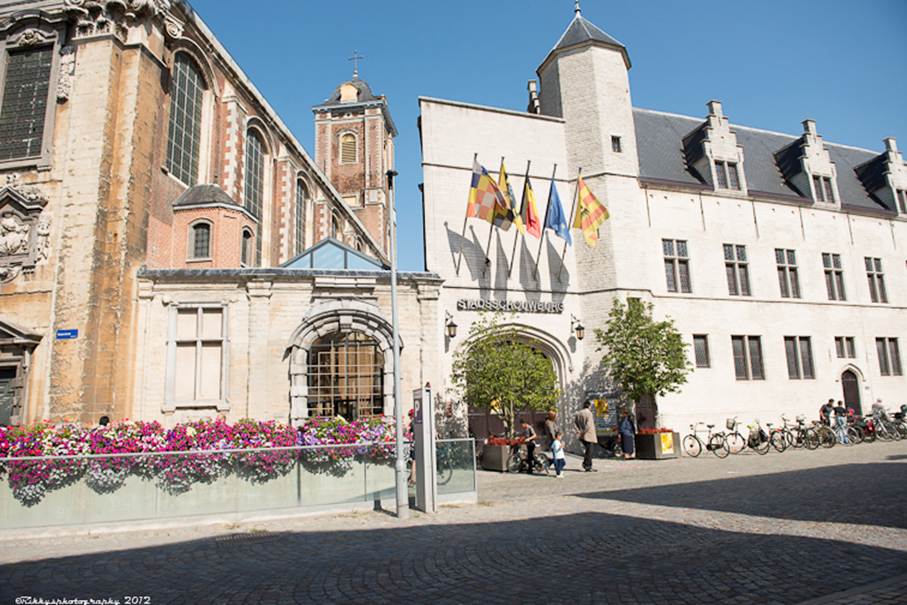
(City theatre in Mechelen today)
A TRAGEDY
In 1958 Flemish public television (now VRT) published the results of an inquiry into music popularity. Number one was operetta followed by “Schlager “(hit) songs. People born before 1900 were still numerous and men and women born between the wars were in their thirties and forties. But the times changed and ended in the greatest music tragedy of the last half of the 20th century: the disappearance of operetta. There are several reasons for the disaster. Of course there was the onslaught of rock. Environmental pollution soon won the interest of younger people who swore by everything arriving from the US. But the genre itself had problems. Many books focusing on class distinction (nobility versus bourgeoisie as in Die Csardasfürstin) seemed so outdated after WW II (though in reality nowadays class distinction – college educated versus professional education – is even bigger). Unbelievable coincidences in operetta resulted in gipsies being high nobility (Der Zigeunerbaron).
Dialogues sounded stilted and even comical. Operetta structure, especially in the popular German language operettas, was rigid. First act: the main couple meets and falls in love; second act: due to misunderstanding they quarrel; third (short) act: they reunite and live happily for the rest of their lives. In short libretti were an example of a decent, quiet, class-conscious, somewhat bigoted society that after a war of unheard cruelties against civilians disappeared. Society became cynical and highly sexualized. In Lehar’s Der Zarewitch the prince invites a new (unknown to him female) companion to practice gymnastics with him and take off a blouse. The lady ardently refuses and the prince discovers a woman. Nowadays such a scene is ridiculous. Not that opera is better. Does anybody believe that Radames would throw away his destiny to become pharaoh for the love of a slave?
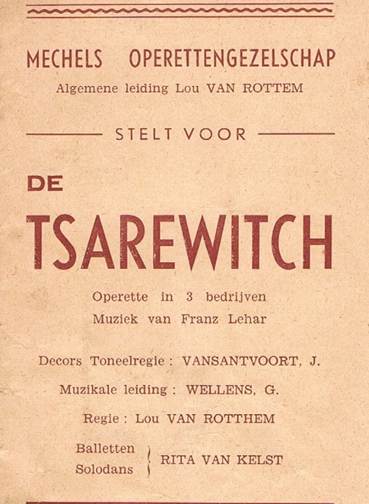
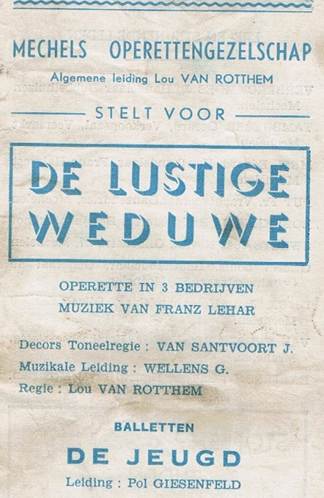
That situation is saved by the music while in operetta dialogues are used to make a silly situation even more sillier. As to music, most popular operettas heavily lean on waltzes for main musical themes and new and exiting rhythms entered only slowly in the scores. Then there was the “Tauberization” of the genre. Nowadays YouTube offers recordings of creators of operettas. This often comes as a cold shower. Operettas were performed by actors who could sing and dance as well but acting was the main raison d’être. The first English language Danilo in Die lustige Witwe just spoke his lines. Watch and listen to Johan Heesters or Hubert Marischka and listen to the same aria with real operatic tenors. With Richard Tauber an important tenor took over some operetta roles and one can understand the enthusiasm of Lehar (or Kalman for young Richard Tucker) for a great tenor performing their music. After WWII recordings proliferated and during the fifties and sixties only top singers recorded operetta while in reality they never sang one on the scene (Elisabeth Schwarzkopf, Fritz Wunderlich, Sandor Konya). People used to radio (playing those records) or buying themselves EP’s or LP’s couldn’t adjust anymore to often voiceless operetta players.
The “LOU”
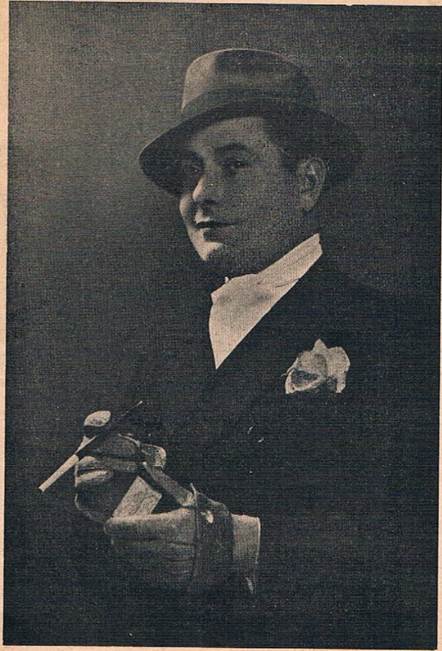
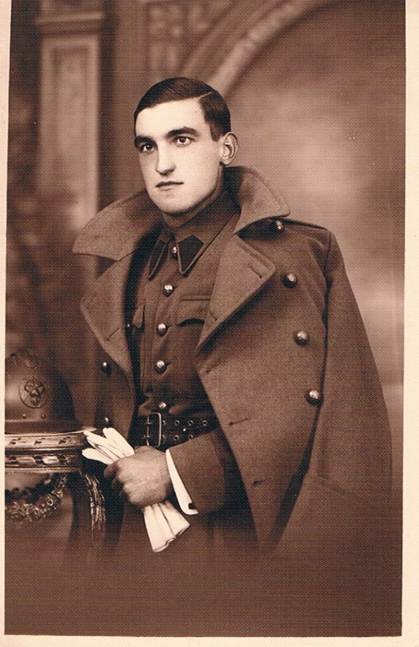
(Lou van Rotthem and Gaston Neckers)
When did I get to know operetta? I don’t know and I suppose I have always known it for the simple reason my father was an amateur singer and actor in the Mechels Operettengezelschap. My home town Mechelen was one of the seventeen provinces of the historic Netherlands. The city is situated between Antwerpen and Brussel in nowadays Flanders (An amalgam of the former counties of Flanders and Loon and the duchy of Brabant). The language is and always has been Dutch. For a time it was known in the Anglo-Saxon world as Mechlin, later on as Malines, a translation in French. Nowadays it is firmly Mechelen in English and Mechlin is only used in Mechlin lace. In 1950 the city counted 60.000 inhabitants. Before the war I am told there were three operetta companies rivalling with each other and the city counted 8 amateur choruses. I have known only two operetta companies. “Jong maar moedig” (“Young but courageous”) was run half professionally but the company of my father was a one man enterprise. Lou van Rotthem, better known as “de Lou” and sometimes as “de zot (fool) van Rotthem” worked his whole life as a clerk in Brussel and devoted his free time to acting without ever aspiring to a professional career. He was a tall and fine young man in the twenties and thirties and he once won a contest for the best look alike of the then famous French actor Henri Garat. But drink and food changed his outlook. After the war he was tired of acting and singing in other companies and devoted all his free time and savings to his own company: Het Mechels operettengezelschap. My father joined it in 1947. The great years of the company were between 1945 and 1955.
Before and during the war operettas (especially German ones) were extremely popular in Flanders. Friederike by Franz Lehar could not be performed in Germany as it presented Goethe as an operetta tenor (and the book was written by Zionist Fritz Löhner who was literally kicked to death in one of the work camps in Auschwitz). In Antwerpen and Mechelen it was seen and heard during the war. Charleroi in Wallonia even performed The Desert Song in French, composed by a very Jewish Sigmund Romberg.
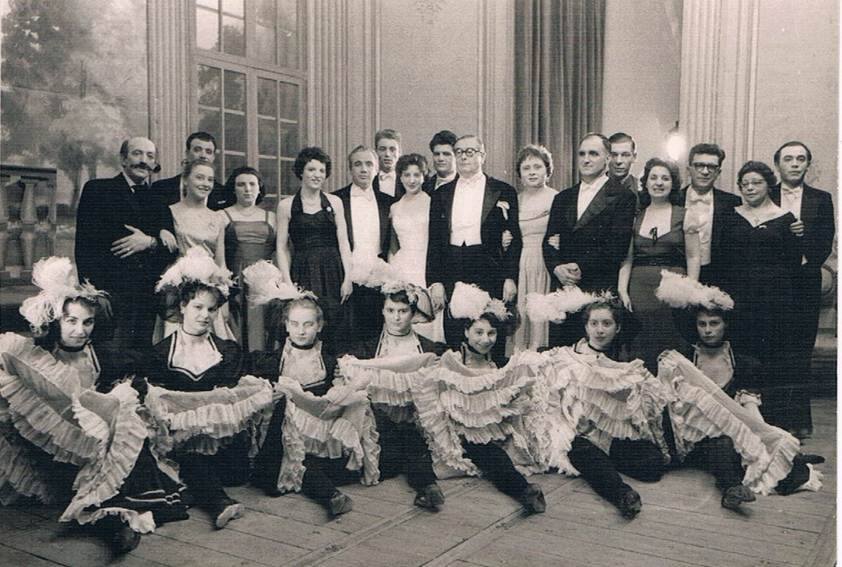
(The company with Lou van Rotthem in the middle)
“De Lou” managed, organized, paid and acted in his company. Most collaborators were volunteers who joined for the joy of acting and singing. During rehearsals they even had to pay for their own drinks. Once a year the Lou offered them a supper. Mechelen was not an exception. Most cities and even villages in Flanders had such operetta companies. Those were the days when people did not passively listen to records as became reality during the sixties but made music themselves. The main roles in Mechelen were often sung by professionals, singers on a less exalted level with a day job as chorus member at the opera or the radio. But Sylvain Adriaensens (listen to him on the YouTube channel of this site), star tenor of the Mechelen and other operetta companies, always kept a job in administration while going from rehearsals and performances during evenings and weekends. The Mechelen orchestra was an ad hoc collection of players who most of the time were members of ball room ensembles. The conductor was a civil servant at the national railways company were after his task as an inspector he conducted the amateur orchestra of the company. (Not unusual at the time though today only the ministry of Finance still has its own amateur orchestra). During the sixties and seventies every company disbanded and only a few survived in the 21st century. Music life professionalized, became heavily dependent on taxpayers money and settled almost exclusively in big cities like Antwerpen and Gent where for a time opera companies performed a lot of operettas until the eighties. Pretentious general managers like Gerard Mortier took over and threw out operettas with an exception for the two scores they thought worthy of opera: Die Fledermaus and Die Lustige Witwe.
THE REPERTORY
What is astonishing is the width of repertory in the years after the war. Not only in Mechelen but everywhere else. Notwithstanding the cruel German occupation German language operettas completely dominated. Of course everything was performed in Dutch and Lehar would have wondered why the Opera voor Vlaanderen (the professional Antwerpen-Gent opera company) performed later on his Witwe in German and not in Dutch (with some Flemish professionals struggling with German in long stretches of spoken dialogue). French operettas were never performed in Mechelen nor anywhere else in Flanders with the exception of the Gent opera. Operettas by Flemish composers were not rare though I was too young to assist. During the forties the Mechelen company performed Sepp’l by Emiel Hullebroeck, for many years a favourite score in Flanders. Tangolita (not to be mixed up with La Tangolita in Abraham’s Ball im Savoy) by Antwerp composer and conductor Eugène Beeckmans and Willem Pouillon’s Peer de Koster also got a run. There were performances of “Avonturen in Hotel Atlantic” composed by a certain A. Nehring. On the internet the only A. Nehring I found was the name of a decorator of the Hamburg Atlantic Hotel.

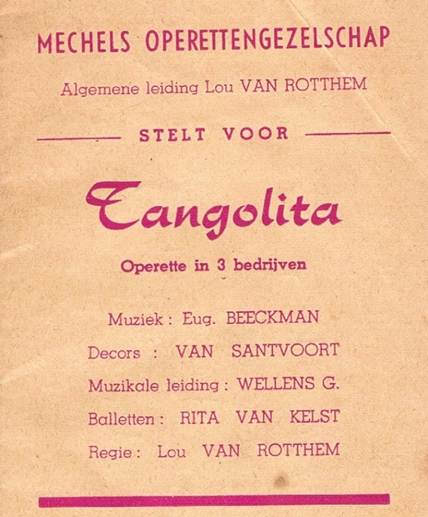
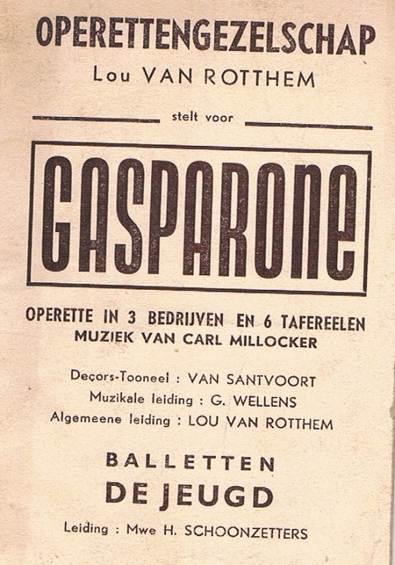
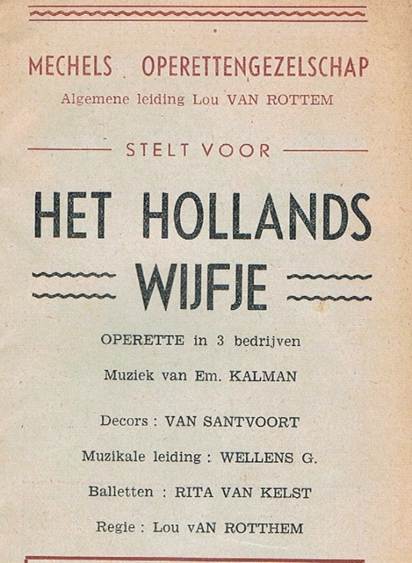
The only Anglo-Saxon piece performed was Youmans’ No, no Nanette. The Lou dreamed of performing the Student Prince but was vetoed by Sylvain Adriaensens. Sylvain was not afraid of competing with recordings by Tauber, Schock, Traxel but Lanza was out of his reach. So the German repertory superseded everything else. From our point of view (and our limited operetta knowledge based upon recordings) there were a lot of rarities in Mechelen though most scores were from less well known works by major composers. I’d dearly love to have heard Ernst Steffan’s Die Toni aus Wien; a tragic operetta on the Austrian-German war of liberation from French occupation in 1812-1813. Steffan is best known for the popular insert he composed for Millöcker’s Gasparone: “Dunkelrote Rosen”. Rare too were Het Lied der Liefde (All performances got Dutch titles), a Korngold concoction of Johan Strauss themes; known by Tauber recording a few arias of Das Lied der Liebe. Then there were Drie arme kleine meisjes (Drei arme kleine Mädels – Walter Kollo) and Fritz Kreisler’s Sissi. Popular before the war but rare afterwards were Bajadere and Het Hollands Wijfje (Das Hollandweibchen) by Kalman and Fall’s Die geschiedene Frau. The most modern and living composer performed in Mechelen, was Nico Dostal with De Hongaarse Bruiloft (Die Hungarische Hochzeit) and Manina (which premiered in 1939 and 1942 in Berlin). Operettas known for vocal scores that nowadays put fear in German opera companies were not unusual such as Zigeunerliebe(Lehar) and Die Dubarry (Millöcker-Mackeben).
Then Mechelen heard perennial favourites, still known by many recordings. German titles: Gasparone, Zarewitch, Gräfin Mariza, Wiener Walzer (popular in France as Valses de Vienne), Die Lustige Witwe, Ein Walzertraum, Maske in Blau, Der fidele Bauer, Das Land des Lächelns, Im weissen Rössl, Der Vetter aus Dingsda, Der tapfere Soldat, Der Graf von Luxemburg, Die Dollarprinzessin, Dreimädelhaus, Frau Luna, Der Juxbaron, Giuditta, Der Graf von Luxemburg, Madame de Pompadour. As far as I remember two operettas were performed every season and each run consisted of three performances on Friday, Sunday and Tuesday. The place to be was the Mechelen City theatre; built in the 18th century by the Jesuits before they were expelled. Bombed by the Germans in 1914 it was rebuilt a few year later and seated 450 people.
MY CONTRIBUTION
What was my contribution? The Lou asked a few times for me joining the company as there were still no laws on child performers and a few children on the scene enlivened a production. My mother adamantly refused as rehearsals were not in the theatre itself but in the meeting room of a café on Friday evenings (I had school on Saturday) and Sunday mornings (Mass). She had no problem with me accompanying her to performances. So my services were limited to rehearsing my father’s lines from the moment I could fluently read at 7. I remember Lehar’s Eva and playing at home smuggler Toffola (my father was his enemy Beppo) in Paganini and reading the hero’s part in Giuditta where my father was Ottavio’s Leftenant Antonio.
PRODUCTION AND SINGERS
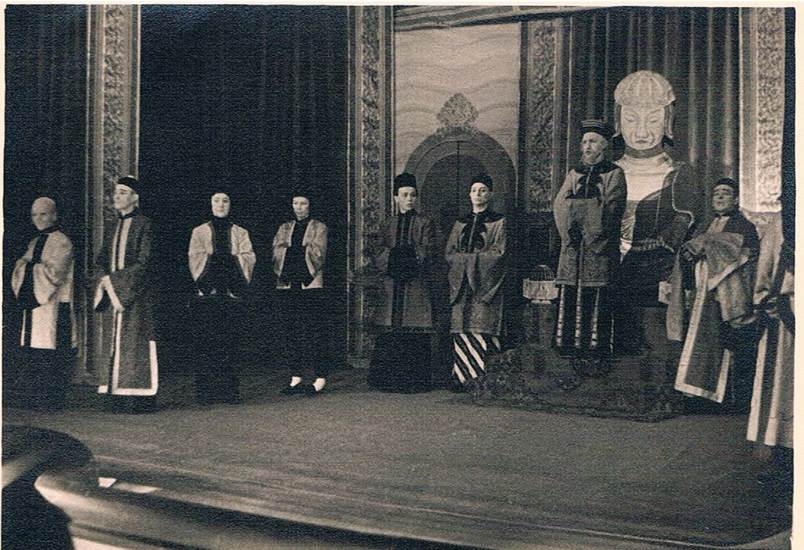
(Das Land des Lächlens)
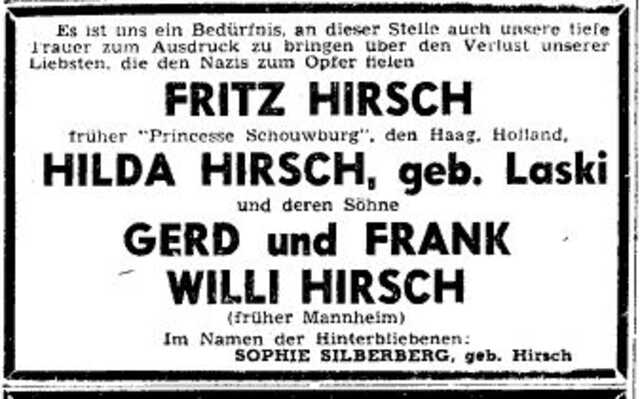
How did the productions look like and how were they performed? I was eight when I first assisted and therefore my memories are somewhat hazy. Anyway everybody looked fine to me and dresses and uniforms were opulent or so I thought as a child from a blue collar worker. A ballet studio offered their pupils to get experience on a scene. Sets belonged to the theatre and were well known cardboard backdrops. And yes, the palace of imperial prince Aljosha in Zarewitch looked very much like Elisa Bonaparte’s place in Paganini. Of course there was no updating of the story and -now somewhat strange to me- even the original names of the characters were rigorously respected. Thus Dutch speaking actors and singers called each other Lindoberer, Matthäus Scheichelrother and Annamirl in Der fidele Bauer. The Lou himself was actor and producer and from time to time I remember a few heated discussions at the counter of the café when I was allowed t pick up my father after mass. Before the war the Lou often visited the Fritz Hirsch Operette company in the Netherlands which performed professionally in German. Hirsch was the Lou’s example as he too directed and produced and all quarrels in Mechelen ended with the Lou ‘s: “Hirsch did it so and so and that’s final”. (Hirsch was assassinated by the Germans in Mauthausen in 1942).
The company’ s main asset was tenor Sylvain Adriaensens. He looked fine, acted convincingly and spoke very understandable Dutch; switching without problems from spoken dialogue to singing. The voice resembled a bit Tauber’s. It carried extremely well in the theatre, was warm with a fine timbre and good legato. Like Tauber it was somewhat short and unless Tauber mezza-voce and piano were not Sylvain’s forte. But I never heard a better tenor in operetta; even not in opera houses in Antwerpen and Gent and the You Tube examples of his art prove my point. Anne Marie Mornay usually sang the female title role. A big almost Wagnerian voice, people said but I have no recording of her. She had been one of the stars of the ill-fated professional Antwerpen operetta company that existed only one year. She left Mechelen for a reason unknown to me and was replaced by beautiful Elfriede Rudolph, the soubrette up to that moment. Fifty years later she recorded a Cd which still proved her vocal talent. Lea Crauwels was the last partner of Sylvain; a good though not exceptional voice.
DECLINE AND END
I was just in time to see productions at their best and I have fine memories of Giuditta, Zarevitch, Juxbaron, Frau Luna, Eva, Paganini, Graf von Luxemburg, Dollarprinzessin. As the fifties went on I noticed empty seats. The Lou adjusted by repeating operettas he had given earlier like Die bajadere and Manina. The hits of Lehar and Kalman which required a lot of extras became more rare. A sure sign of decline was his casting of the second couple. More and more he gave important roles to members who sold a lot of tickets to family and friends. Rarities disappeared with one exception: Leo Asscher’s Hoheit tanzt Walzer which could do with a small cast. Performances dwindled to a few each year. By 1960 my father bought a small Philips tape recorder and I set it up backstage and recorded Der fidele Bauer (listen on our You Tube Channel). We had a lot of visitors at home wanting to know how they sounded. Asscher’s Hoheit got the same treatment and as far as I know this is the only recording of a complete Asscher operetta. In 1963 the company folded up with Künneke’s De neef uit het Oosten (Der Vetter aus Dingsda); an operetta without chorus and ballet. We had just bought a bigger tape recorder and we thought it too expensive to bring it to the theatre; a decision I still regret. The city of Mechelen in those days didn’t hand out subsidies and even doubled the fee for hiring the theatre. The Lou couldn’t pay anymore fees, royalties, costume hire etc. It was the sad end of a career of almost forty years of love of operetta. A few years later his younger wife unexpectedly died and the Lou couldn’t cope without her and drank himself to death.
Jan Neckers (September 2026)